Featuring insights from Morten Larsen, Workbooks
If you’ve worked in B2B marketing for ANY more than five minutes, you know the age-old story.
You’ll work tirelessly to launch a campaign, downloads spike, and the team triumphantly hands over a batch of ‘hot leads’ to the sales team. A week later, Sales claims the leads were “complete junk,” half the phone numbers were wrong, and no one was ready to buy.
Marketing blames Sales for failing to follow up; Sales blames Marketing for chasing vanity metrics. Eurgh.
But the root cause of this frustration isn’t a lack of effort – it’s subjectivity.
For a long time now, Marketing and Sales have evaluated their lead quality using completely different rulebooks, relying on static lead-scoring models and purely gut feelings without a single source of truth.
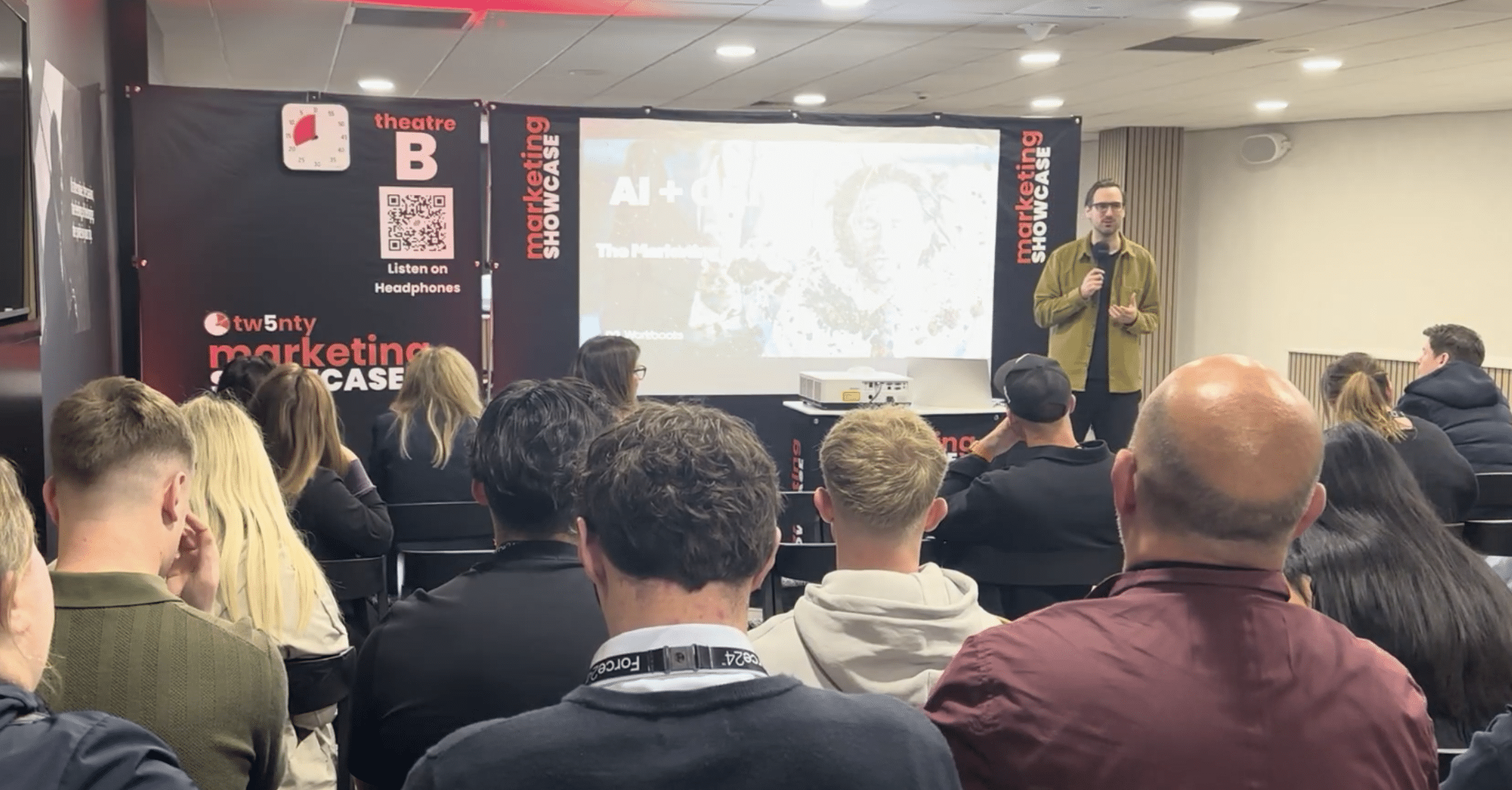
At a 2026 marketingSHOWCASE event in Newcastle, Morten Larsen from Workbooks took our 5 in Twenty stage to deliver a groundbreaking session on how B2B organisations are finally ending this war: ‘The connection between Sales and Marketing in B2B.‘
Morten revealed how combining AI with a modern CRM architecture transforms lead evaluation from a subjective argument into an objective science.
The Problem: two teams, two languages
Why has B2B lead alignment been so difficult to solve?
Historically, Marketing defined a lead based on activity (e.g., downloading a whitepaper, attending a webinar, or visiting the pricing page twice). Sales, on the other hand, defines a lead based on commercial reality (e.g., budget, decision-making authority, immediate operational need, and timeline).
This disconnect created three major friction points:
- Arbitrary point systems: Traditional CRM lead scoring relied on arbitrary manual points (e.g., +10 points for a click, +20 for a form fill). A student downloading five PDFs could easily score higher than a C-level executive reading a single case study.
- Siloed data: Marketing data lived in automation platforms; sales data lived in opportunity pipelines. Neither team had full visibility into the true end-to-end buyer journey.
- The blame game: Without objective criteria, post-campaign reviews devolved into opinions rather than data-driven adjustments.
The Breakthrough: objective lead quality via AI + CRM
Morten demonstrated that the “holy grail” of alignment isn’t about forcing Sales and Marketing to agree in a meeting room—it is about using intelligent systems to establish unbiased, objective lead scoring.
By embedding AI capabilities directly into the central CRM framework, B2B organizations can instantly bridge the gap between initial engagement and closed revenue.
Here is how the AI + CRM engine creates total objectivity:
1. Pattern recognition over point-scoring
Instead of relying on human assumptions about what makes a good lead, AI algorithms analyze years of historical CRM data. The system evaluates every closed-won deal against historical touchpoints, firmographics, tech stacks, and intent signals to identify the exact DNA of a high-converting prospect.
2. Real-time predictive intent
When a new lead enters the CRM, AI doesn’t just count page clicks; it evaluates the context of engagement. It cross-references buyer behavior against actual sales outcomes, assigning a conversion probability score grounded in historical facts, not marketing optimism.
3. Unified sales and marketing feedback loops
Because the AI operates inside the shared CRM environment, every interaction recorded by sales reps (call notes, email replies, objection handling) continuously trains the algorithm. If Sales marks a lead as disqualified, the AI learns why and automatically refines Marketing’s target scoring model in real time.
What this means for the wider business
When you replace subjective opinions with AI-driven CRM objectivity, the dynamic between Sales, Marketing, and the C-suite shifts dramatically:
- Elimination of friction: Sales reps no longer waste hours cherry-picking or ignoring leads—they receive a prioritized, AI-vetted queue of prospects with clear context on why they are ready to buy.
- Higher marketing credibility: Marketing stops reporting on surface-level downloads and starts proving direct contribution to qualified pipeline and revenue.
- Predictable revenue growth: With a single source of truth, CFOs and CEOs gain transparent, predictable forecasting based on objective pipeline health rather than guesswork.
Stop arguing about leads. Start structuring your data.
The feud between Sales and Marketing was never about personality clashes – it was a data problem. By unifying your Sales and Marketing teams around a centralised CRM backed by predictive AI, you take the emotion out of lead evaluation and build a repeatable revenue engine.
Want to catch more rapid-fire, pitch-free masterclasses from top B2B strategists?
Join us live at an upcoming marketingSHOWCASE event at the Tottenham Hotspur stadium, 15th September to hear from industry leaders, test-drive modern MarTech tools, and network with your peers.
Get your FREE tickets here