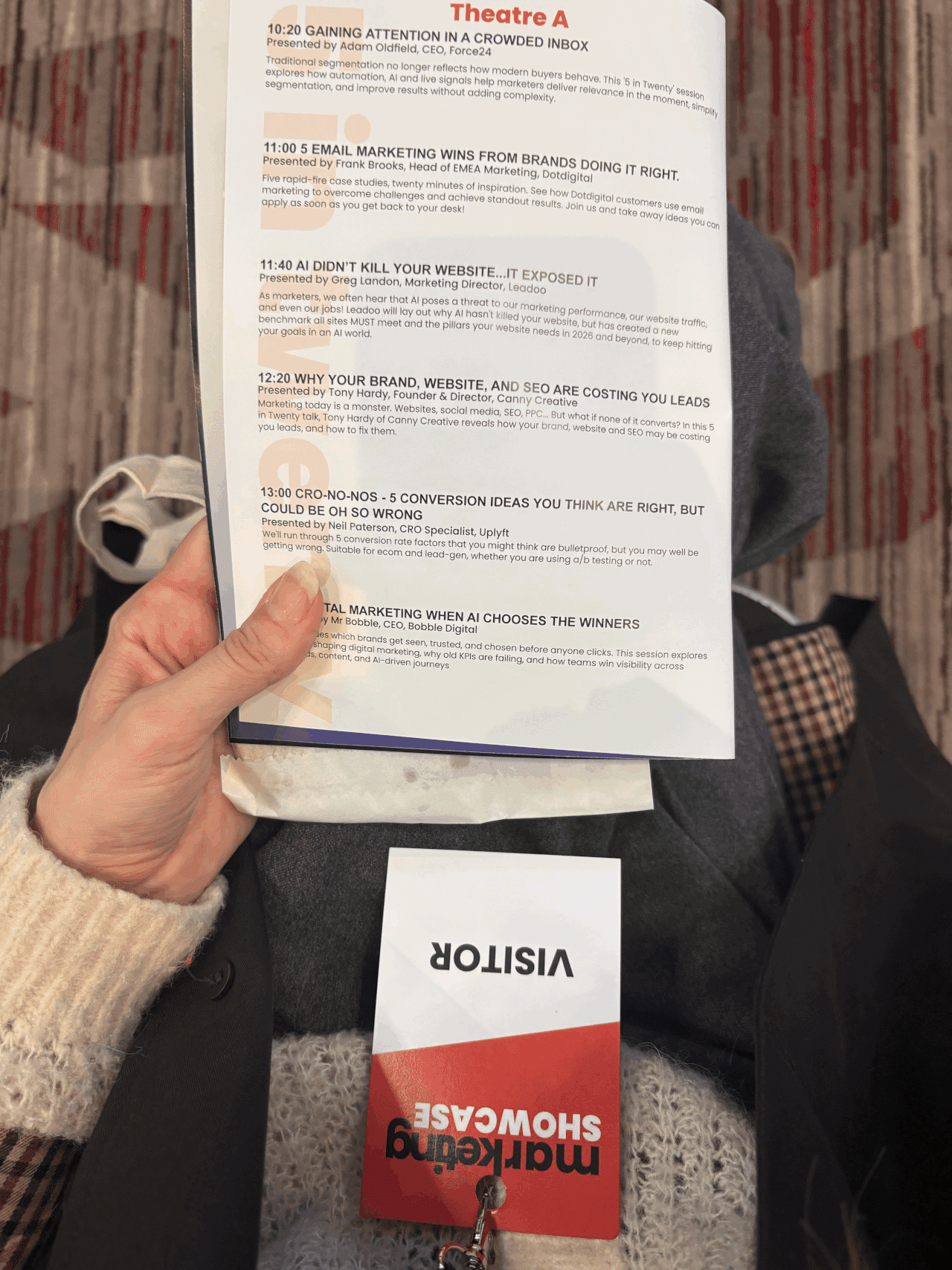
The marketing world is currently obsessed with ‘The End.’ The end of SEO, the end of the website, the end of the human marketer. But if you spent any time at marketingSHOWCASE Twickenham, you’ll know that the reality is far more interesting.
AI hasn’t come to kill your strategy; it has come to act as a giant, high-definition mirror. It is exposing the cracks that were already there – the lazy automation, the generic content, and the lack of a clear ‘Why.’
As one of our visitors perfectly summarised after the event: The fundamentals of marketing haven’t changed. How we execute them has.
Here are the seven hard truths that the 2026 marketing landscape just made impossible to ignore – from a visitor’s perspective of the 5 in Twenty sessions:
1. The organic social myth: reach vs. growth
We need to have an honest conversation about ‘Organic.’ If your Facebook posts are reaching 1–2% of your followers and Instagram is struggling to hit 5%, you don’t have a growth engine; you have a digital noticeboard.
Organic social is brilliant for nurturing the community you already have, but it is no longer a discovery tool. Growth comes from reaching new people. In 2026, you cannot rely on organic reach alone. You need a joined-up approach that plays to each channel’s strengths and accepts that ‘pay to play’ is the entry fee for scale.
2. The chase for distinctiveness
Products are similar. Pricing is competitive. Features are easily copied. In a sea of ‘sameness,’ the only thing that survives is a strong, unmistakable voice.
Distinctiveness is your armour against AI-generated mediocrity. If a chatbot can write your brand’s mission statement, you don’t have a brand – you have a template. What survives in 2026 is original thinking, a unique viewpoint, and a brand personality that is impossible to replicate.
3. The new website benchmark: The AI experience
Your website is no longer being compared to your competitor’s website; it is being compared to a user’s experience with AI.
Modern buyers expect conversational, instant, and adapted responses. If your site is a static brochure with a “Contact Us” form that takes 24 hours to trigger a response, you have already lost. People want relevance in the moment. Is your website an answer engine, or is it an obstacle course?
4. ‘Email for Everyone’ is Email for no one
Impersonal personalisation – where you just slap a [First_Name] tag on a generic blast- is officially dead.
The most successful email marketers are saying more to fewer people. By segmenting by behaviour and funnel stage, you ensure that your message is a value-add, not an intrusion. If you aren’t delivering specific relevance to a specific person at a specific time, you are just contributing to the ‘crowded inbox’ problem we discussed with Force24 at Twickenham.
5. SEO Isn’t dead – boring content is
We’ve heard the ‘SEO is dead’ funeral march for years. The truth? People are still searching; they are just tired of finding the same regurgitated articles.
SEO in 2026 is about utility. Tell people exactly how to do the things they are looking for. Provide the ‘Information Gain’ that search engines now crave. Measure what’s working, iterate on the data, and repeat the process. SEO isn’t a technical hack; it’s a commitment to being the most helpful resource on the internet.
6. The one-sentence test: The strategy audit
Without strategy, your brand is just a collection of pretty assets. To find out if your strategy is actually working, ask yourself these questions:
- Can every employee explain what you do in one sentence?
- Do Marketing and Sales describe the business the same way?
- Are you answering questions your competitors are afraid to touch?
- Does your website support one clear, obvious call to action?
If you can’t answer “We help X achieve Y so they can Z,” your marketing is likely just ‘noise.’
7. The golden rule: be less boring
It sounds simple, but it is the hardest thing to execute. Being ‘less boring’ means taking a clear message and finding a new way to deliver it. It means putting the Audience First and playing to the strengths of the medium.
Whether it was Webmart’s take on the Greggs vegan sausage roll or Bobble Digital’s insights into AI journeys, the message from Twickenham was clear: Novelty is the gateway to attention.
Keep the Conversation Going on theHUB
Did you miss the sessions at Twickenham? Or did you attend and want to re-watch the talks that sparked these insights?
We have moved all the podcasts, video sessions, and deep-dive blogs from the event over to theHUB. It is your central library for all the “know-how” shared at our shows.